
B12 Guide
How Much B12 Do You Need After Gastric Bypass Surgery?

By David Gans · Gastric bypass patient since January 2024 · Lost 231 lbs · Founder of BypassVitamins.com
I started noticing it around month four after surgery. Fatigue that felt different from normal tired. A kind of foggy feeling in my head that would not lift. My labs showed my B12 was dropping.
That was a wake-up call. I had been taking my multivitamin but not paying close attention to whether it had enough B12. It did not.
Vitamin B12 is one of the most important nutrients to track after gastric bypass. And it is also one of the easiest to get wrong if you are not paying attention to what your supplement actually contains.
Here is everything I have learned.
ASMBS B12 Recommendation
350-1,000mcg daily for all weight loss surgery patients. Target: 1,000mcg/day. Best forms: sublingual tablet, chewable, or liquid. Not: standard swallowed tablets.
Comparing bypass vitamins? See all 15 options ranked by price →
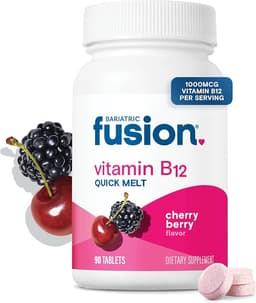
Bariatric Fusion
Vitamin B12 Sublingual 1000mcg
Sublingual methylcobalamin (active form), formulated by a bariatric surgical team, sugar free.
Buy on Amazon →Why does gastric bypass affect B12 absorption?
When to Test Your B12 After Bypass
Target blood level at every test: above 400 pg/mL
Gastric bypass changes how your body absorbs vitamin B12 at the biological level. Before surgery, B12 absorption depends on a protein called intrinsic factor, which is produced by cells in your stomach. Your stomach also produces hydrochloric acid, which helps release B12 from food.
After Roux-en-Y gastric bypass, your stomach is made much smaller. The part of the stomach that produces the most intrinsic factor and acid is largely bypassed. This means the normal B12 absorption pathway does not work the same way anymore.
Your body can still absorb B12 through passive absorption, which does not require intrinsic factor. But this process is much less efficient. You absorb only a small fraction of each dose through passive absorption. That is why the recommended doses after bypass are much higher than for someone who has not had surgery.
How much B12 do you need after gastric bypass?
The ASMBS and Johns Hopkins both recommend a daily target of 350-1,000mcg of vitamin B12 after gastric bypass. Most bariatric programs aim for 1,000mcg daily as a practical target.
This is dramatically higher than the standard recommended daily intake of 2.4mcg for healthy adults. The higher dose is needed because your body is only absorbing a small fraction through passive diffusion.
The form of B12 also matters. The most effective forms for bypass patients are sublingual (dissolved under the tongue), chewable, or liquid B12. These forms bypass normal digestive absorption routes and are absorbed directly through the mucous membranes.
Standard swallowed tablets are less effective because they rely on the normal stomach absorption process that no longer works as well after bypass.
What happens if you do not get enough B12?
B12 deficiency develops slowly. In the early stages, you may feel nothing at all. This is one of the reasons it is dangerous. You can have low B12 for months before symptoms appear.
When symptoms do show up, they can include extreme fatigue, weakness, tingling or numbness in your hands and feet, difficulty walking, memory problems, and depression. In severe cases, B12 deficiency can cause permanent nerve damage.
The nerve damage from B12 deficiency is called subacute combined degeneration. It affects the spinal cord. It can be irreversible if left untreated long enough.
This is why regular blood testing matters. Do not wait for symptoms. Get your B12 tested at every follow-up appointment.
Does your bariatric multivitamin have enough B12?
Not all bariatric multivitamins contain adequate B12. This surprised me when I first started researching products.
Some popular bariatric multivitamins contain only 100-200mcg of B12. That may not be enough to maintain healthy blood levels after bypass, especially in the long term.
When reading a label, look specifically for at least 500mcg of B12. Many quality bypass multivitamins contain 1,000mcg or more. If your current multivitamin has less than 500mcg, talk to your bariatric dietitian about adding a separate B12 supplement.
Sublingual B12 tablets dissolve under the tongue in 30 to 60 seconds and are easy to add to your routine. They are available over the counter and relatively inexpensive.
Check which bypass multivitamins contain 500mcg or more of B12. See our full comparison ranked by price per day.
Compare Bypass Vitamins by B12 ContentWhat form of B12 is best after bypass?
The most commonly recommended forms after bypass are methylcobalamin or cyanocobalamin, in sublingual, chewable, or liquid format. Both forms are effective. Some practitioners prefer methylcobalamin because it does not require conversion by the body, but either form works well when taken in adequate doses.
Avoid standard swallowed B12 tablets as your only source. The absorption through normal digestion is unreliable after bypass.
B12 injections are another option and are used when oral supplementation is not maintaining adequate blood levels. Your doctor can administer these, or you can learn to self-inject. Monthly injections of 1,000mcg are a common protocol for patients who do not respond well to oral supplementation.
How often should you test your B12 levels?
Your B12 should be tested at every routine blood draw after bypass. Standard follow-up schedules for bypass patients include labs at three months, six months, one year, and then at least once per year for life.
Target range for B12 in the blood is typically 200 to 900 pg/mL. Bariatric programs often aim for levels above 400 pg/mL to maintain a buffer. If your level falls below 200, you are clinically deficient and supplementation needs to be adjusted immediately.
Do not skip your blood draws. You can feel perfectly fine with a B12 level that is dropping toward deficiency. The test is the only way to know.
Can you take too much B12?
B12 is water soluble. Your body excretes what it does not need through urine. There is no established tolerable upper intake level for B12, and toxicity from oral B12 supplementation is not a known concern at standard doses.
Taking 1,000mcg daily is safe and well within the range recommended by ASMBS. If you are in doubt about your specific dose, ask your bariatric dietitian.
The bottom line on B12 after gastric bypass
Vitamin B12 deficiency is one of the most common nutritional deficiencies after gastric bypass. It is preventable with the right supplement and the right dose. It is detectable through regular blood testing. And it is reversible when caught early.
The key numbers to remember: aim for 1,000mcg of B12 daily, in sublingual or liquid form, and test your blood levels at every follow-up. Check your multivitamin label. If it contains less than 500mcg of B12, add a separate supplement.
Your nerves will thank you.
B12 Quick Reference
Daily target: 1,000mcg. Best form: sublingual, chewable, or liquid. Check label: look for at least 500mcg per serving. Test: every follow-up blood draw. Target blood level: above 400 pg/mL.
Ready to find your best bypass vitamin?
We compared all 15 options by price per day, iron content, and full ASMBS nutrient breakdown. Updated weekly.
Compare All 15 Bypass Vitamins →Frequently Asked Questions
How do I know if my B12 is low?
The only reliable way is a blood test. Early B12 deficiency usually has no symptoms. By the time symptoms like tingling or fatigue appear, deficiency may have been present for months. Get your B12 tested at every follow-up appointment.
Is sublingual B12 really better than swallowed tablets after bypass?
Yes for most bypass patients. Sublingual B12 dissolves under the tongue and absorbs directly through the mucous membranes, bypassing the digestive pathway that has been altered by surgery. Swallowed tablets rely on the normal stomach absorption process, which is less reliable after bypass.
Can I get enough B12 from food after bypass?
Not reliably. Even if you eat B12-rich foods like meat and fish, the altered digestive anatomy after bypass means your body cannot absorb B12 from food as efficiently as before surgery. Supplementation is required for life.
Related Articles
What Vitamins Do You Need After Gastric Bypass?
A complete guide to iron, B12, calcium, and vitamin D after Roux-en-Y.
Read →How Much Iron Do You Need After Gastric Bypass?
Iron is the most common deficiency after bypass. Exact doses and best forms.
Read →Best Multivitamin After Gastric Bypass (2026)
Ranked by price per day. See which multivitamins have adequate B12 and 45mg iron.
Read →